Which SDSU Basketball newcomer has the highest ceiling?
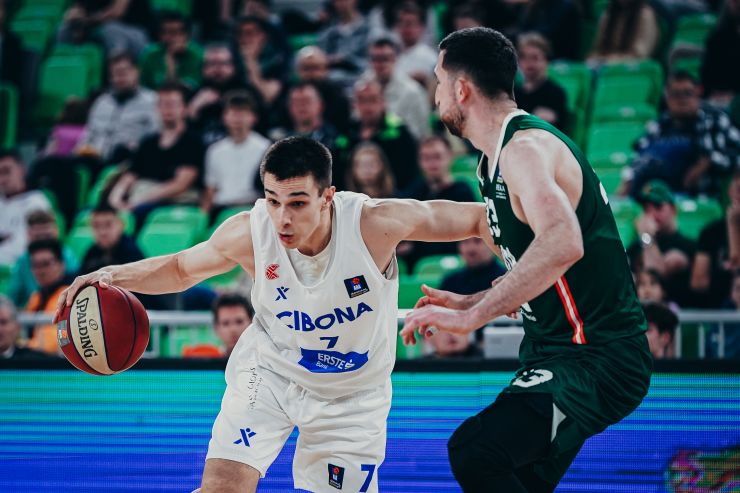
Credit: ABA League

There’s a difference between being the best player on a college basketball team and being the player with the highest ceiling.
San Diego State’s 2026-27 roster makes that distinction especially interesting, and then the offseason made it unavoidable.
Nick Anderson, the Rice transfer who looked like the cleanest plug-and-play scorer on the roster, suffered a knee injury that will cost him the entire 2026-27 season. The player with the highest floor is off the board. What’s left is a roster built almost entirely out of ceiling bets, and that changes how this conversation works.
The Aztecs didn’t simply reload this offseason. They diversified. Brian Dutcher added proven scoring, international versatility, physical front-court help, and multiple guards and wings with very different developmental curves. The result is a roster where “ceiling” can mean three entirely different things: offensive creation, positional archetype, or two-way athletic impact.
Chance Gladden may become the offensive engine. Luka Skoric may be the rarest archetype. Latrell Davis, the name that keeps getting louder inside the program, may be the player whose ceiling matters most to what this team actually becomes.

Chance Gladden: The Safest Path to Star-Level Guard Play
Gladden enters SDSU with the clearest offensive résumé among the newcomers.
At Boston University, he averaged:
- 14.4 points
- 4.5 assists
- 3.2 rebounds
- 47.6% shooting
- 86.7% free-throw shooting
What stands out isn’t just the production. It’s the control. Gladden already plays like a lead guard who understands tempo, spacing, and manipulation in ball screens. He consistently gets into the paint without losing balance or forcing difficult reads. That matters at SDSU, where offensive mistakes are punished, and decision-making is non-negotiable. A lot of young guards can score. Fewer can efficiently organize offense while carrying real creation responsibility this early.
That’s what makes Gladden different, and with Anderson out, the offense doesn’t just want Gladden to become the engine — it needs him to.
Latrell Davis: The Ceiling That Keeps Rising
Here’s the take: Davis is the fastest-rising name in this entire conversation, and it’s not particularly close.
He’s not a newcomer — he redshirted for SDSU in 2025-26 — but that redshirt year is exactly why his ceiling profile looks different now. While the roster churned around him, Davis spent a full season inside Dutcher’s system: practicing against SDSU defensive standards, rebuilding his body, and sharpening the jumper without burning eligibility. Redshirt years at SDSU are not parking spots. They’re investments, and Dutcher does not invest in players he doesn’t plan to use.
The production base was already real. At San Jose State, Davis put up:
- 11.1 points per game
- 45%+ shooting
- Roughly 38% from the 3-point range
- Strong rebounding and defensive activity for a guard
But the more important factor is how Dutcher talked about him publicly last season. The language surrounding Davis consistently sounded less like a “developmental piece” and more like someone the staff already viewed as an impact-level fit inside SDSU’s structure. There’s a receipt, too: just days after the season ended, Dutcher said he believed the Aztecs would have been an NCAA Tournament team if Davis hadn’t redshirted — that, based on practice alone, he would have been an everyday player. That matters because Dutcher historically does not hand out trust easily — especially defensively. Players don’t earn that kind of public framing at SDSU by accident.
So stack it up: explosive straight-line athleticism, proven college production, a full developmental year inside the system, and coach-validated trust. That’s not a wildcard profile anymore.
That’s a launch pad.
Then the Anderson injury happened. The perimeter scoring void Anderson leaves behind doesn’t get filled by one player — it gets filled by opportunity. Davis is the single biggest beneficiary. The minutes are there. The usage is there. The runway is there.
If the jumper stabilizes, Davis doesn’t just become a rotation player. He becomes a legitimate two-way perimeter weapon — the emotional tone-setter whose athletic profile expands what SDSU can look like physically on both ends. The ceiling conversation used to be a two-player debate. Davis forced his way into it. Now he’s threatening to take it over.
Luka Skoric: The Rare Modern Wing Archetype
Skoric represents an entirely different kind of upside.
At 6-foot-9, the Croatian wing fits one of the most valuable archetypes in modern basketball: size, shooting, and movement versatility on the perimeter. Last season with KK Cibona, he shot 36.2% from 3-point range while showing the mobility to project as a legitimate spacing forward at the college level. His ceiling isn’t about usage; it’s about lineup transformation.
When Skoric becomes a competent defender within SDSU’s system — and the system has a long track record of getting players there — he changes how the Aztecs can play. The forward provides five-out spacing, inverted pick-and-roll actions, transition mismatch creation, and stretch-forward versatility.
That type of player is rare in SDSU’s historical roster construction. His ceiling is less about certainty and more about structural impact. Yes, there’s an adjustment period between flashing offensive tools in European basketball and surviving the physical demands of high-level American college basketball. That’s the swing, but a 6-foot-9 wing who shoots and moves is the kind of swing programs take on purpose, entering a new conference.

Isaiah Sy: The Replacement with a Different Ceiling Than the Original
When Anderson went down, Dutcher didn’t sit on the loss. He struck fast, landing Isaiah Sy — a 6-foot-7 wing from Oregon State who was among the best players still available — and in doing so, he may have traded floor for ceiling. Sy’s 2025-26 numbers at Oregon State were:
- 10.0 points per game
- 4.6 rebounds
- 35.4% from 3-point range on 5.5 attempts per game
- 29 starts in 33 games, 28 minutes a night
The shooting identity is extreme in the best way. Sy is one of just 26 players nationally who have taken at least 67.5% of their shots from beyond the arc, and his 104 3-pointers over the last two seasons are more than any Aztec made in that same span. He’s a high-volume, high-gravity floor spacer with a 6-foot-10 wingspan and a self-described identity as a defensive communicator.
Here’s why his ceiling case is sneaky-interesting: Anderson was a guard whose value was spacing. Sy is a wing whose value is spacing, with four extra inches of length and real 3-and-D projection. He won’t replicate Anderson’s shot-making polish, and the efficiency inside the arc needs work. But a 6-foot-7 movement shooter who defends and rebounds is a more scalable piece in the Pac-12 than a finished-product scoring guard.
One year of eligibility means his ceiling is compressed into a single season. The motivation won’t be a problem — he gets his old team twice. The villain arc writes itself.
The Wild Cards: Torresani, Vincini, and Cherry
David Torresani may ultimately become the safest overall system fit among the internationals. The Italian guard already plays with professional structure and mature decision-making. The shooting projects cleanly, and players with his feel tend to survive quickly in disciplined systems because they rarely break possessions.
Luca Vincini is harder to project. At 6-foot-9 with professional experience in Italy, the tools are intriguing. The passing touch, interior skill, offensive feel, and lineup versatility are exciting fans across the Mesa. But almost everything about his ceiling depends on one question: Can the jumper become real? If it does, he becomes a modern connective frontcourt piece capable of unlocking spacing lineups. If not, he’s probably more rotational than transformational.
Jeremiah “Bear” Cherry may have the lowest offensive ceiling of the group, but that doesn’t make him less important. SDSU needed physicality, rebounding, and interior stability entering the Pac-12 transition. Cherry immediately helps solve those problems. Sometimes the highest-floor players are the ones who allow everyone else’s ceiling to matter.
The Anderson Factor
It’s worth saying plainly: losing Anderson hurts. His 15.5 points and 40% from 3-point range at Rice were real production, and he projected as the most mature offensive fit on the roster. His absence is the reason this article reads the way it does. But injuries don’t just remove players; they redistribute ceilings. Gladden’s creation load grows. Davis’s runway opens. Sy exists on this roster at all because of it. The 2026-27 Aztecs will be defined less by who they lost in June and more by which of these bets cashes.
Final Verdict: Skoric Has the Highest Ceiling — But Davis Is Coming for It
If the question is purely about ceiling and the highest possible long-term outcome, the answer is still Luka Skoric — because archetype matters.
A 6-foot-9 wing who can shoot, move in space, and potentially defend multiple positions is one of the most valuable player types in modern basketball, and it’s exactly the player type the Pac-12 punishes you for not having. But here’s the honest tension heading into the season: Skoric’s ceiling is theoretical. Davis’s ceiling now has infrastructure — a year in the system, a coach who already trusts him, and a scoring void with his name on it. Skoric is the bigger swing. Davis is the swing most likely to connect first.
Entering the Pac-12 era, SDSU doesn’t need one of these bets to hit. It needs two.
The ceiling conversation isn’t a debate anymore — it’s a race.

Nice article. Well written. A4L!