Padres Down on the Farm: Projecting the 2026 Fort Wayne TinCaps
Credit: TinCaps

This article is the third in a series of articles highlighting roster projections and team predictions for Padres minor league affiliates. We continue the series with the Padres’ High-A affiliate, the Midwest League’s Fort Wayne TinCaps.
The Fort Wayne TinCaps have one of the most exciting rosters in the Padres’ organization coming into the 2026 season, as plenty of Padres top prospects are projected to open the season in the Midwest League.
The TinCaps shook up their coaching staff this offseason, as manager Lukas Ray was not retained, taking on a minor league coordinator role in the Blue Jays organization. In his place, the TinCaps have brought back Jonathan Mathews into the skipper’s seat; Mathews was at the helm in the TinCaps’ last playoff appearance back in 2023. Pitching coach Thomas Eshelman also departed the organization, taking on an upper-level pitching coordinator role with the Orioles. Former big leaguer Yorman Bazardo was assigned to coach the team’s pitchers and enters his fourth season as a coach in the organization.
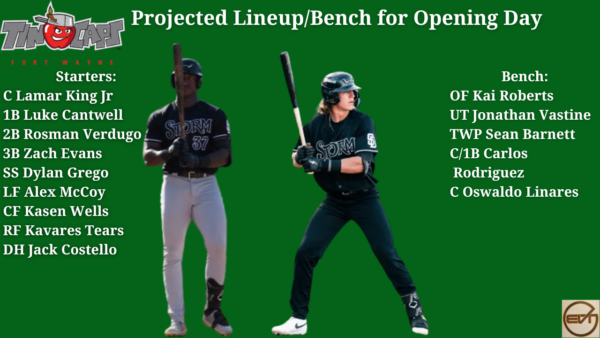
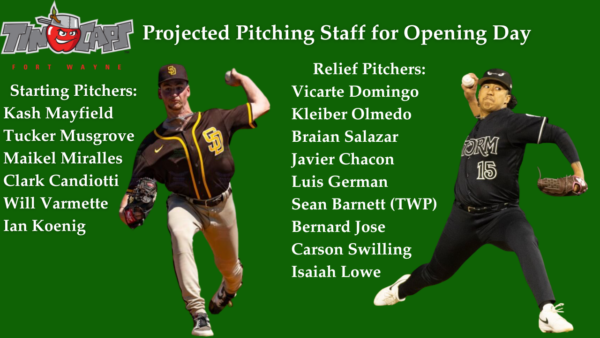
Below are projected lineups and pitching staffs for the TinCaps in 2026:
Fort Wayne is set to be a team to watch in the Midwest League, simply due to the present talent. With that being said, here are some predictions for this team related to the players on the roster or the team’s performance as a whole.

1. Kavares Tears sets a new career-high in home runs.
Quite frankly, had the Ad Monster not existed, there is a chance that Kavares Tears finished the 2025 season with 15-20 homers. The former Tennessee Volunteer showed solid power potential in his pro debut, as 37 of his 93 hits went for extra bases. Tears’ pull-side power was on full display, which played a role in him being the Storm’s home run leader in 2025.
The dimensions at Parkview Field are comparable to those at his former home stadium (Lindsey Nelson Stadium in Knoxville). Tears also showed that he can hit the ball with authority to the opposite field, so he doesn’t need to pull the ball all the time to have success. While Tears did not see the same level of offensive output away from The Diamond at Lake Elsinore compared to at home, the change of scenery and further growth in his pitch recognition and approach can unlock his potential even more than what has been seen so far in his young career. Remember, he only had one full collegiate season’s worth of starting reps before getting drafted. If 2025 was the trailer, 2026 could be the full feature film.
2. Sean Barnett sees more time on the mound compared to at the plate.
This pick is bold compared to some of the others in this piece, as Barnett struggled on the mound to the tune of a 21.09 ERA in 10.2 innings. At the plate, however, he posted a 94 wRC+ in 260 plate appearances. Barnett hit five home runs, drove in 29 runs, and drew walks in 11.5% of his total plate appearances.
Though Barnett was good against fastballs in the California League, his upside is arguably higher on the mound. When he was pitching, his fastball averaged 93-96 while topping out at 97 mph with a hard upper-80s slider. His delivery is fluid, without any hitches, and allows his two pitches to sequence well out of the same arm slot. Barnett has continued to play both ways through fall instructs and Spring Training, but if his perceived upside on the mound is higher than at the plate, look for him on the mound at Parkview Field.
3. The starting rotation finishes the season as a top 5 unit in the Midwest League.
The Midwest League is notoriously a pitcher-friendly league, especially in the early months with colder weather. These conditions can definitely work in pitchers’ favor, and the TinCaps are set to have their own talented bunch. Kash Mayfield, the Padres’ No. 3 prospect, is likely to open the season there after a dominant debut campaign in Lake Elsinore. Mayfield, who posted a 43.6% ground ball rate at Single-A last season, is the kind of arm who can benefit from the Midwest League’s setting.
Mayfield averaged between 15 and 18 inches of induced vertical break at Lake Elsinore, and these numbers could be on the higher end with the temperatures in Fort Wayne. Getting that rise on the fastball would allow the changeup to play up due to the separation in iVB between the two. The same effects could allow the left-hander to further refine his slider. The pitch had depth, but was lacking definition in its shape. Pitching in this environment, with further work with Padres and TinCaps coaches, could allow the breaking ball to unlock another gear.
The breakdown on Mayfield is a good microcosm of how the TinCaps’ staff can see a positive effect in the environment, and is taken into account for this team prediction. Looking at the rest of the rotation, Tucker Musgrove’s stuff has scouts and evaluators salivating regardless of where he is pitching. If Musgrove can maintain his velocity into the summer and pitch deeper into games as the year progresses, he will be able to stake his claim to a starting role long term. Maikel Miralles, while not being the same kind of strikeout arm as Mayfield and Musgrove, traded whiffs for a career-best 49.3% ground ball rate in 2025.
Paired with a sharp defensive infield, Miralles has the opportunity to emerge as a definitive starter if the command improves. Clark Candiotti and Ian Koenig fall into the same category, as both rely on north-south arsenals to generate soft contact. Candiotti is an arm to keep in mind, as the right-hander posted a whopping 28.9% strikeout rate in 48.1 innings before an injury shortened his season. If he can shake off the injury concerns, he could be the next unsung breakout in the system. Then there’s right-hander Will Varmette, who enters the season as a full-time starter for the first time in his career. Varmette has shown impressive strikeout potential in his brief time in Fort Wayne last season, in a small sample, even holding one of the best teams in Midwest League history to one run over four innings in his final start. Having spent the offseason sharpening his secondary pitches to remain a starter, the right-hander could be another arm to rise in the system.

4. The TinCaps finish as the best base-stealing team in the Midwest League.
Stolen bases were not the TinCaps’ forte in 2025, as they ranked last in stolen bases in the Midwest League. Now, going from last to first in this stat is not a traditional worst-to-first situation, but the TinCaps enter the season with the personnel to be able to do such a thing. Kasen Wells, for example, led the California League in steals last season before missing time due to injury, but was still fourth in the league when he returned six weeks later.
Lamar King Jr had some of the best stolen base marks for a catcher in the minor leagues in 2025. Alex McCoy went 14-for-17 in stolen bases in 58 games at Lake Elsinore. Dylan Grego and Jonathan Vastine showed some potential on the basepaths in their final collegiate seasons, each finishing with a 75% success rate on steals in 2025. The personnel on the roster as individuals have the potential to be solid to above-average, but it will depend on coaching decisions, just how effective the team’s baserunning prowess becomes.
5. Zach Evans and Alex McCoy finish the season with offensive production at least 20% better than league average.
Zach Evans and Alex McCoy had success in their time at Lake Elsinore, each in their own way. Evans played in 96 games at Lake Elsinore and posted a 110 wRC+ on the back of strong plate discipline and clutch hitting in high leverage situations. McCoy posted a 146 wRC+ with strong power and batted-ball results in 53 games. Both had their strengths last season, which play into their projected positions in the TinCaps’ lineup. Evans was the only one of the two to finish the season in Fort Wayne, but struggled in 105 plate appearances to end the season.
Both players have been hard at work over the offseason to set themselves up to be successful in 2026, and they have already shown the potential to be above-average contributors at the dish early in their careers. Evans has worked on adding muscle this offseason to further develop his power, as he has the size to generate raw power at 6-foot-4. McCoy has worked on improving his game defensively while working on the coordination to get the most out of his swing. For players of McCoy’s size (6-foot-6), finding consistency in one’s swing can at times be a challenge, but keeping a simple approach (as he is working on, per his interview with EVT) will allow him to make further strides in his offensive output.
The TinCaps open their regular season on April 3 on the road against the Great Lakes Loons, with their home opener set for April 7 against Lansing.

A born and raised San Diegan, Diego Garcia is a lifetime Padres fan and self-proclaimed baseball nerd. Diego wrote about baseball on his own site between 2021-22 before joining the East Village Times team in 2024. He also posts baseball content on his YouTube channel “Stat Nerd Baseball”, creating content around trades, hypotheticals, player analyses, the San Diego Padres, and MLB as a whole.
A 2024 graduate of San Diego State, Diego aims to grow as a writer and content creator in the baseball community.