Examining Jackson Merrill’s regression since his rookie campaign
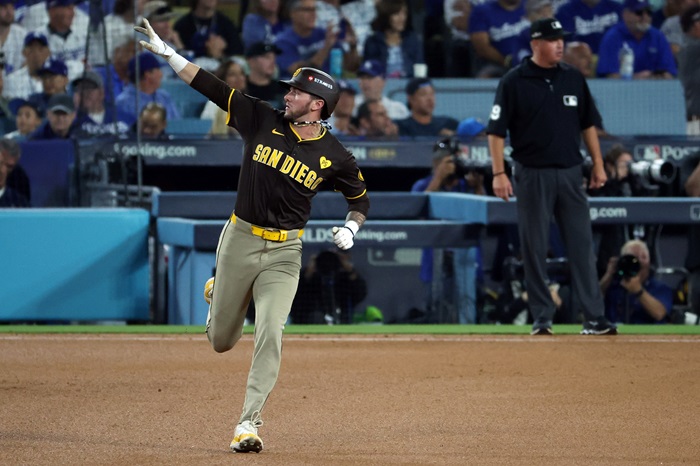
Mandatory Credit: Kiyoshi Mio-Imagn Images

In the midst of his third major league season, Jackson Merrill looks like a completely different player than the dominant player we saw during his rookie 2024 season. He has actually subsequently declined in many different offensive stats since his MLB All-Star and Silver Slugger campaign back in 2024.
In April 2025, Merrill signed a contract that would keep in San Diego for nine more years with a salary that guarantees him $135 million. The extension keeps Merrill under club control through the 2034 season with a club option for 2035.
Fernando Tatis Jr. is also under club control through the 2034 season. The combo of Merrill and Tatis Jr. for the foreseeable future looked to be a great outfield duo, but they’ve both hit a wall this year. Tatis Jr. has even moved to second base, weakening the outfield even more.
It’s very common for a player to break into the majors and perform well in his first season then take a step back during their second year. After one season of play, opponents will start to figure out tendencies, strengths, and weaknesses.
While Merrill did regress a bit from 2024 to 2025, he hasn’t shown the ability to rebound. Each season has been worse from the last. His offensive production thus far in 2026 has fallen off a cliff even from last season.

Let’s examine the situation.
Where Has His Power Gone?
During his 2024 rookie season, Merrill hit 24 home runs while driving in 90 runs. He hit for an excellent .292 batting average along with a .826 OPS. As far as surface numbers go, Merrill set career highs in doubles (31), home runs (24), runs batted in (90), batting average (.292), on-base percentage (.326), and slugging percentage (.500).
All those numbers dropped last year for Merrill and in terms of batting average, on-base percentage, and slugging percentage, they’ve continued to drop again this 2026 year. He only has 14 extra-base hits so far to pair with a poor slash line of .194/.267/.309.
Merrill established himself as a power hitter during his debut season when he hit 24 home runs but his batted-ball metrics in terms of power and exit velocity have seen a steady decline. His expected slugging rate currently sits at a .398 clip where it previously was .547 in 2024.
His career best barrel rate came last year with a 13% mark, but it’s down to 9.5% this season. Merrill’s average exit-velocity has dropped each season from 90.4 mph, to 89.7 mph, and now 89.5 mph. Even with this trend, Merrill has never hit a ball harder than 111.6 mph in his career. That 111.6 mph hit came back in 2024 and his hardest hit ball thus far in 2026 and left the bat at 108.7 mph.
Isolated power is a good stat to examine a hitter’s raw power at the plate. Merrill posted a career best .208 isolated power in 2024 which is well above the average mark that generally sits between .140 and .150 according to FanGraphs. This year Merrill’s isolated power has plummeted to a below average .115 mark.
He made a really good first impression with the bat during his first season with the San Diego Padres. His batting run value ranked in the 88th percentile. Fast forward to 2026 and his batting run value puts him in the 7th percentile. He went from being a threat at the plate to someone who hasn’t been able to produce and play to his standards.
Harder Time Making Contact
Even though he’s gotten his walk rate up to an average 8.5% clip this season, his strikeouts have increased each of his last three seasons — 17%, 22.4%, 25.9%. Looking into the peripherals behind his plate discipline, something concerning stands out — his ability to make contact.
A big problem that caused Merrill some recent troubles at the plate is his ability to make contact. On pitches in the zone during 2024, he was able to make contact with 86.1% of pitches — an above average mark. Over his least two seasons including this year, Merrill’s zone-contact rate has dropped to approximately 81% which is slightly below average.
Merrill has proved to chase out of the zone at an unhealthy 35.6% career rate — league average sits at 28.5%. Where contact comes into play here is Merrill’s ability to make contact on pitches outside the zone. The same trend continues again here where he only excelled during his rookie season. In 2024, he made contact with 64.6% of offerings outside the strike zone but that mark has since dipped to 55% this year and last.
Overall Merrill made contact 81% of the time in 2024 but has sat at 75.5% and 74.7% for the last two respective seasons. The trend here ties closely to his batting average that peaked at .292 but now sits at .194.

Hi, my name is Cade Lalim. I live in Southern California and I’m a huge baseball fan. I am a senior at Laguna Beach High School and will be attending Irvine Valley College starting in the fall of 2026. My goal is to work in the baseball industry whether that’ll be journalism or with a team. I’m super excited to contribute to San Diego Padres coverage here on East Village Times.