Projecting the 2026 San Diego Padres’ Draft (Rounds 1-10)
Credit: Getty Images

The San Diego Padres are poised to add an influx of talent into the organization at the upcoming 2026 MLB Draft. On a day when dreams are made for many young ballplayers, the Padres are among the clubs looking to help bring those dreams to life.
As we did here at EVT last year, let’s dive into our draft projections (or mock draft if that is your preferred term). As was the case in 2025, we will provide picks for the first ten rounds, along with other players who could be in consideration for the later rounds.
Before we begin, the Padres have a draft bonus pool of $9.5 million this year. That pool is meant for signing bonuses for all 20 rounds, plus any undrafted free agent signings.
Without further ado, let’s dive right into the 2026 Padres draft projection.
Round 1 – 21st Overall – SS Taj Marchand, James Island High School (SC)

San Diego aims high for prospects with all the physical tools to stand out despite industry concerns, and Taj Marchand has been one of the sneakiest climbers this draft season. Coming out of high school in South Carolina, Marchand has posted some of the most intriguing metrics in this draft class. Despite an aggressive approach, Marchand does not swing and miss as much as one would expect for a player with his approach. His swing has an unconventional setup and could be the kind to scare away some evaluators, but he has quick hands to the ball and can bring the barrel to the baseball to generate ideal contact.
His bat speed is one of the best in the class, especially when ranked against other high school draft-eligible players, which allows him to generate power despite a flatter attack angle compared to his peers. When watching the tape on Marchand, he makes good swing decisions and has shown a strong understanding of the strike zone, which helped him post a 97th percentile strikeout rate on the summer exhibition circuit. Even with some of the quirks in his offensive game, Marchand projects to be a potential 20-25 home run bat if he can smooth out his swing and work on driving the ball to the pull side, as his opposite field power is already quite prodigious.
Whippy bat speed from SS Taj Marchand. Showed a 107 backside and a 109+ shot back up the middle. A few 108 pull-side bombs. Polarizing swing, but he’s never stopped hitting. pic.twitter.com/Kr0PJe011G
— Joe Doyle (@JoeDoyleMiLB) June 23, 2026
When it comes to his defensive profile, Marchand has a balanced profile with arm, range, and instincts. Marchand’s arm is the kind that has seen him throw up to 92 mph on the mound, giving him one of the strongest arms among the class’s high school shortstop prospects. Marchand’s footwork at the position is rock solid, and he has shown a strong internal clock that allows him to move to the ball and make routine and not-so-routine plays. His lateral movement is stronger than when he has to charge forward on a ball at this point, and he has shown occasions where a play on the run is not his strong suit.
Due to both his height and frame, Marchand can make some of the tougher plays on a dive or in the hole at shortstop, which lends to his ability to stick at the position long term. Some scouts debate whether he will grow into more speed given his frame and size already, which could present some viability at third base or the outfield in the future. Even so, Marchand has the physical tools to stick at the position and be a plus contributor on offense, exactly what San Diego looks for in a prospect (see: Jackson Merrill).
Round 2 – 60th Overall – OF Peyton Bonds, Rutgers
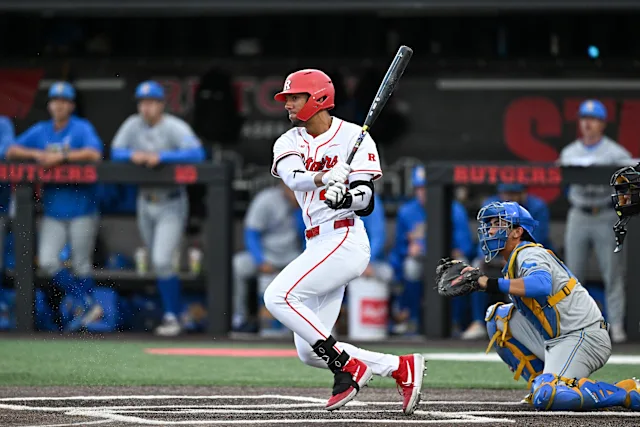
An absolute unit of a human, Peyton Bonds has really begun forging his own path. The son of former Padres draftee Bobby Bonds Jr, the nephew of Barry, Peyton Bonds’ physical tools and raw power are the stuff scouts dream of. While Bonds’ power numbers this season were not eye-popping (six home runs, 14 extra-base hits), it is worth noting that Bonds only played in 36 games. The right-handed hitter slashed .352/.436/.535 with a .972 OPS, .183 isolated power, and delivered a 129 wRC+ in his junior season. Bonds’ walk and strikeout rates were also strong, at 9.6% and 12.7%, respectively. While Bonds’ raw power is the kind that some would call prodigious, he was able to be one of the best contact hitters in the NCAA, as his 90.9% zone-contact rate was third amongst batters who posted a minimum EV90th percentile of 107 mph or above. His showing at the MLB Combine exemplified that, as the right-handed Bonds posted a max exit velocity of 113 mph.
Peyton Bonds, OF
A 6-foot-5, 230-pound righthanded hitter with a great physical toolset that features plus raw power and plus speed. Bonds posted the 5th-highest 90th percentile EV at the MLB Draft Combine opening day, at 110.6 mph. The Rutgers outfielder jumped 45 spots in BA’s… pic.twitter.com/2AiJvrO3sf
— Baseball America (@BaseballAmerica) June 25, 2026
Physically, the 6-foot-5 Bonds brings energy out in center field. His speed is above average, especially for a player of his size. Watching him play center field, Bonds is the kind of player who is faster than he looks when on defense, with a strong ability to track the baseball. Bonds has at times looked overmatched with some balls hit over his head. His pure size and solid (but not eye-popping) arm strength paint him as a future corner outfielder, as his fielding is strong but not the main calling card. Bonds’ power potential and ability to make contact will certainly be tested by pro pitching, but he has all the tools to become a middle-of-the-order bat with plus power.
Round 3 – 97th Overall – RHP Ruger Riojas, Texas
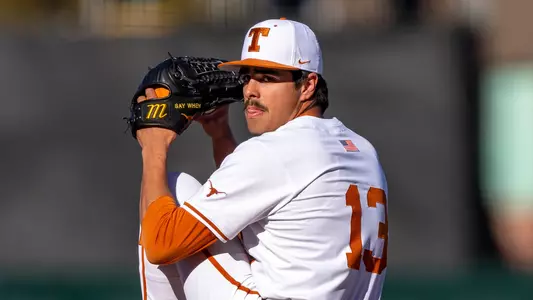
The SEC is a true farm for elite pitching talent, and Ruger Riojas is one of the not-so-well-kept secrets in the conference when it comes to pitching talent. After two seasons at UT-San Antonio, Riojas transferred to Texas, where the Longhorns’ player development staff developed him from an arm with relief risk to the kind of arm they trusted to make big-time starts. Riojas started his tenure with the Longhorns as a two-pitch pitcher, but those days are long gone; the right-hander has registered a six-pitch mix in 2026. Riojas was actually draft-eligible in 2025, but opted against making the jump to the pros. In hindsight, it appears that the right-hander made the right decision.
Riojas’ fastball is interesting, as he sits 94-96 mph with regularity. The fastball possesses strong rising action coming from a flat-ish plane, which allows him to be successful with the pitch up in the zone. Riojas generates elite extension down the mound, which allows his fastball to play up beyond its already strong rise. The right-hander’s secondaries encapsulate his “kitchen sink” approach. Riojas’ slider has been revamped and reinvented since he arrived in Austin, as the slider is now more of a sweeping breaking ball with velocity on the higher end for a slider. The pitch takes a sharp turn as it approaches home plate, making it an effective weapon against right-handed batters.
To counter left-handed batters, Riojas employs a devastating split-finger that tunnels incredibly well off of his fastball. The splitter’s command has at times evaded Riojas, but when he can locate the pitch, good luck. While the splitter has been a work in progress, Riojas’ newfound cutter may have overtaken it as an equalizer. Riojas throws a hard cutter that has both sharpness and velocity. The cutter sits in the upper 80s while also possessing a knee-buckling break. The pitch was particularly successful low in the zone, as the late movement enticed batters to chase.
Texas RHP Ruger Riojas is back in the Top 100 after a hot start in 2026. Up almost 70 spots. Riojas is routinely in the upper-90s and throwing the kitchen sink.
He’s once again positioning himself as a second or third round pick.
?FULL TOP 250?pic.twitter.com/cCtPsdareB
— Over-Slot Baseball (@OverSlot_) March 2, 2026
With his development at a college powerhouse over the past two seasons, Riojas has become a player who will be one of the most targeted senior signees of the draft class. The right-hander has the tools and potential to remain a long-term starting pitcher at the next level, and if he can continue his success as he did in college, he could very well be a quick riser up the minor league ladder, something the Padres have not had in a long time.
Round 4 – 124th Overall – 2B Nu’u Contrades, Arizona State
It’s not often that a middle infielder receives the “star” label at the college level, but Nu’u Contrades is the sort of player who has achieved such notoriety. The Hawai’i native started as a true freshman, and over the course of his college career, has matured into one of the most well-rounded hitters in the Big 12. The redshirt junior slashed .366/.434/.762 with 21 HRs and 15 2Bs this season, and his 12% strikeout rate was superb. Contrades is the kind of player who stuck with one program in the modern age of NIL and the transfer portal, and remaining with the Sun Devils has allowed him to blossom.
Contrades’ offensive output was 52% better than average in the Big 12, and he flashed all five tools in some shape or form. His swing decisions and ability to make contact are interconnected, as he has an aggressive approach that sees him chase out of the zone. A 28.6% chase rate would indicate that a batter whiffs a lot, but that is not the case here; Contrades’ 20.6% whiff rate and 37% out-of-zone whiff rate ranked in the 61st and 63rd percentile,s respectively. His offensive approach has seen him produce, as he has shown a consistent ability to get the barrel to the baseball throughout the 2026 campaign. His swing does draw some comparisons to that of Ha-Seong Kim (just on the eye test), though Contrades keeps the barrel in and through the strike zone enough to generate above-average quality of contact.
Nu’u Contrades was a barrel machine for @ASU_Baseball ?@nuucontrades x @rapsodo pic.twitter.com/eD9yaYV3sO
— D1Baseball (@d1baseball) July 8, 2026
Defensively, Contrades has been rated with an average glove at both second and third base, albeit with strong defensive instincts. He has a good first step when moving on defense, both laterally and forward. His speed grades out as average, with some scouts and evaluators projecting room for growth in this area. While the arm strength is average to slightly-above-average, his defensive IQ allows him to play a solid second or third base at the collegiate level. While he may become more of a utilityman at the professional level, Contrades’ bat will dictate his progression at the professional level.
Round 4C – 134th Overall – RHP Cal Scolari, Oregon
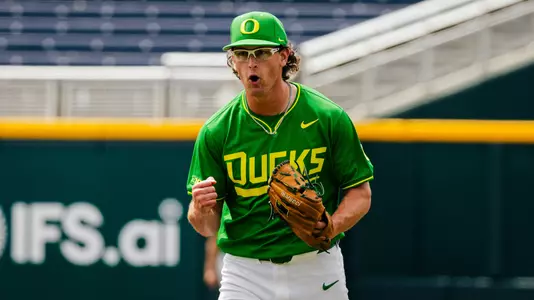
The 2025 West Coast Conference Pitcher of the Year, Scolari parlayed a strong season at the University of San Diego into a transfer deal to Oregon. In his first season with the Ducks, Scolari pitched to a 3.32 ERA in 54.2 innings of work. The right-hander’s strikeout stuff from USD leaped forward with Oregon, as he struck out 34.7% of batters faced with a 14.3% walk rate. The right-hander showed off an impressive four-pitch mix, headlined by a 93-96 mph fastball. The heater touches 98 mph early in outings, as Scolari can really rear back and reach for it when needed. The fastball’s movement profile is rather interesting, as he possesses the fabled cut-ride action on the fastball. As a result, the pitch is devastating in the top half of the zone and sequences well with the rest of his arsenal.
Scolari has refined his breaking ball into two separate offerings, a power slider between 85-88 mph and a more traditional 1-7 curveball that possesses around 2700 rpm’s at 79-82 mph. Both on their own are strong when paired with the fastball, as there is little variance in release point. However, the shape of the pitches can at times blend into one another, so consistency in the breaking balls is something that can be developed with professional coaching. Scolari also features a changeup in the high-80s, though it is more of a tertiary, break glass in case of emergency offering in its current state.
Cal Scolari (@calscolari) looked the part of one of the best Sunday arms in the country in @OregonBaseball‘s series-clinching win at UC Santa Barbara ?
6 IP
0 R
2 H
2 BB
9 K? https://t.co/VejAoPfZFj pic.twitter.com/1NO1sjgv2h
— D1Baseball (@d1baseball) March 30, 2026
Scolari was rumored to be an early Day 2 pick in 2025, and he remains likely to be selected within the first five rounds. The right-hander has the traits to be a starting pitcher in professional baseball, with the potential of a No. 2 – No. 3 starter, though his ceiling will most likely be dictated by his ability to throw strikes and pitch deeper into games.
Round 5 – 157th Overall – 3B/OF Tre Phelps, Georgia
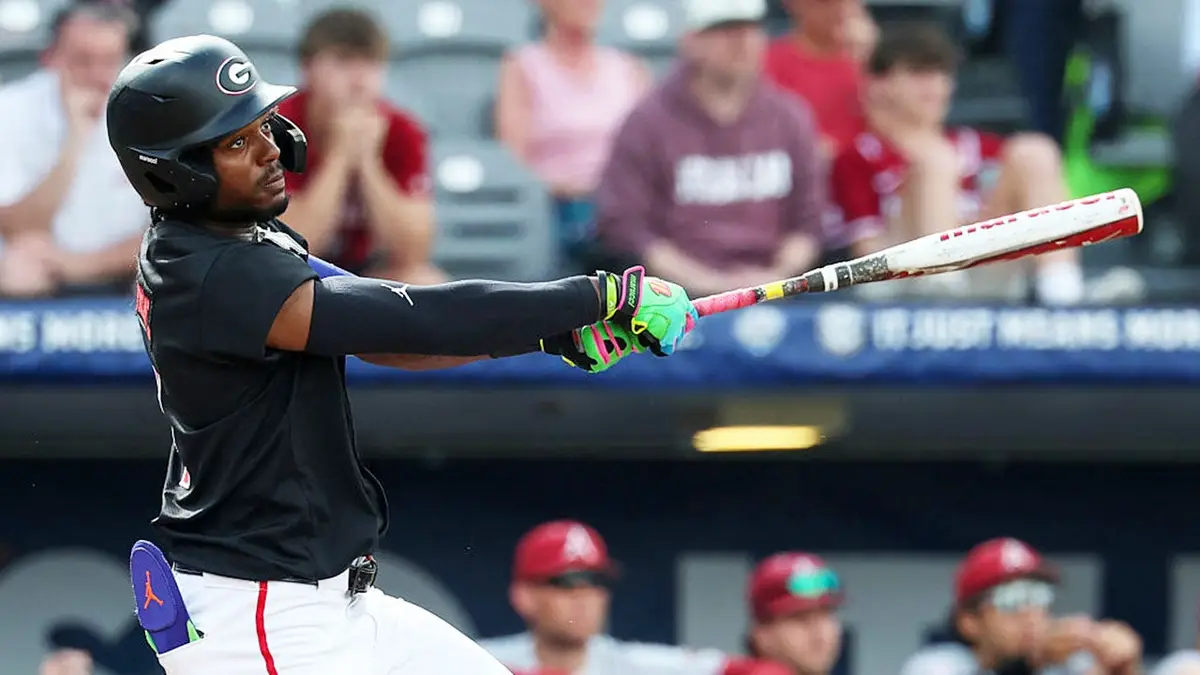
Tre Phelps would be a consensus top 100 prospect in this draft if he had a consistent defensive position, as his bat is potent enough to make him valuable at any position. While the Georgia Bulldog saw time at third base and the outfield this past season, the moving around did not slow his bat down. In a full season’s worth of at-bats, Phelps posted a 143 wRC+, slashing .348/.468/.628 with a 1.096 OPS and .280 isolated power.
Phelps crushed 19 home runs and 29 total extra-base hits, and swiped eight bases as well. The right-handed hitting Phelps posted a 94th percentile barrel rate, which saw him drive the ball with authority to all fields. He has an aptitude for how his swing works, and this cerebral approach has allowed him to generate ideal launch angles without banking on pulling the ball. This doesn’t mean he can’t pull the ball, as he put on display in the Athens Regionals against Liberty (if you watch college baseball, you know exactly which swing I mean). Phelps’ bat really carries his prospect profile, as he has the potential to be a table-setter and a run producer all in one.
BIG BLAST FROM TRE PHELPS!
3-run home run to make it 4-0 Georgia over Mississippi State ? pic.twitter.com/nfaB8GVsw6
— The College Baseball Show (@CollegeBSBShow) April 2, 2026
Defensively, he has the tools to be a solid defender, but is missing a defensive home. Phelps has plus speed that can allow him to close on balls in the gaps, but he has not seen enough time in the outfield to make concrete conclusions about his aptitude for the position. While some evaluators see his lack of positional stability as a detriment, Phelps has the speed, quickness, and internal clock at the plate that can carry over into the field. Finding him a position on the field and developing those defensive tools will be a part of his developmental journey at the professional level, but if he can do such a thing, he has the potential to become a starting-caliber player at the Major League level if his offensive instincts translate to the wood bat environments of pro baseball.
Round 6 – 186th Overall – 2B/OF Jet Berry, Queen Creek HS
The younger brother of former Marlins first-rounder Jacob Berry, Jet Berry is the kind of scrappy, hard-nosed prospect that traditional scouting praises, but has the tools to back it up. A switch-hitter, Berry’s swing from either side works to get him on base in any shape or form. Berry has power to the pull side from either side of the plate, but his raw power isn’t going to bring one to the edge of their seat. However, he can laser the ball into the gap consistently, which plays into his strengths. The swing is smooth and keeps the barrel in the zone, with his flat swing path allowing him to generate line drives almost on command. While he does expand the zone and doesn’t draw many walks, he can get the ball to all fields, even when he doesn’t pull off his “A-swing”.
Jet Berry (‘26, AZ) is one of the better draft names in the state. Twitchy athlete that runs well. Switch-hitter with top of the order traits. #ForksUp commit #PGHS @PG_Draft @QCHS_Athletics pic.twitter.com/hSBp6QNiAm
— Perfect Game Four Corners (@PG_FourCorners) April 14, 2026
When on the basepaths, Berry is every bit of a sparkplug as one would like (and then some). Described by some as twitchy, Berry has one of the best baserunning IQ’s in the draft class. He’s the kind of baserunner who actively gets into the pitcher and catcher’s heads, and his jumps on stolen bases exhibit such traits. Berry knows he has the speed and is not afraid to use it. His speed is such that he can score from first base on balls to the warning track.
At just 19 going into the draft, Berry has time to find his home defensively. He has played both second base and left field, and saw occasional time at shortstop on the exhibition and tournament circuit. While he has the instincts and range to play shortstop, his long-term home is likely second base or left field due to his average arm strength. His footwork is strong enough to allow him to be successful at either position, though he will need steady reps at one or both positions to unlock his defensive tools and their potential. Projecting high school talent can be hard, but if there is an organization that can mold a toolsy high school prospect, San Diego is one such organization.
Round 7 – 215th Overall – RHP Alex Petrovic, Auburn
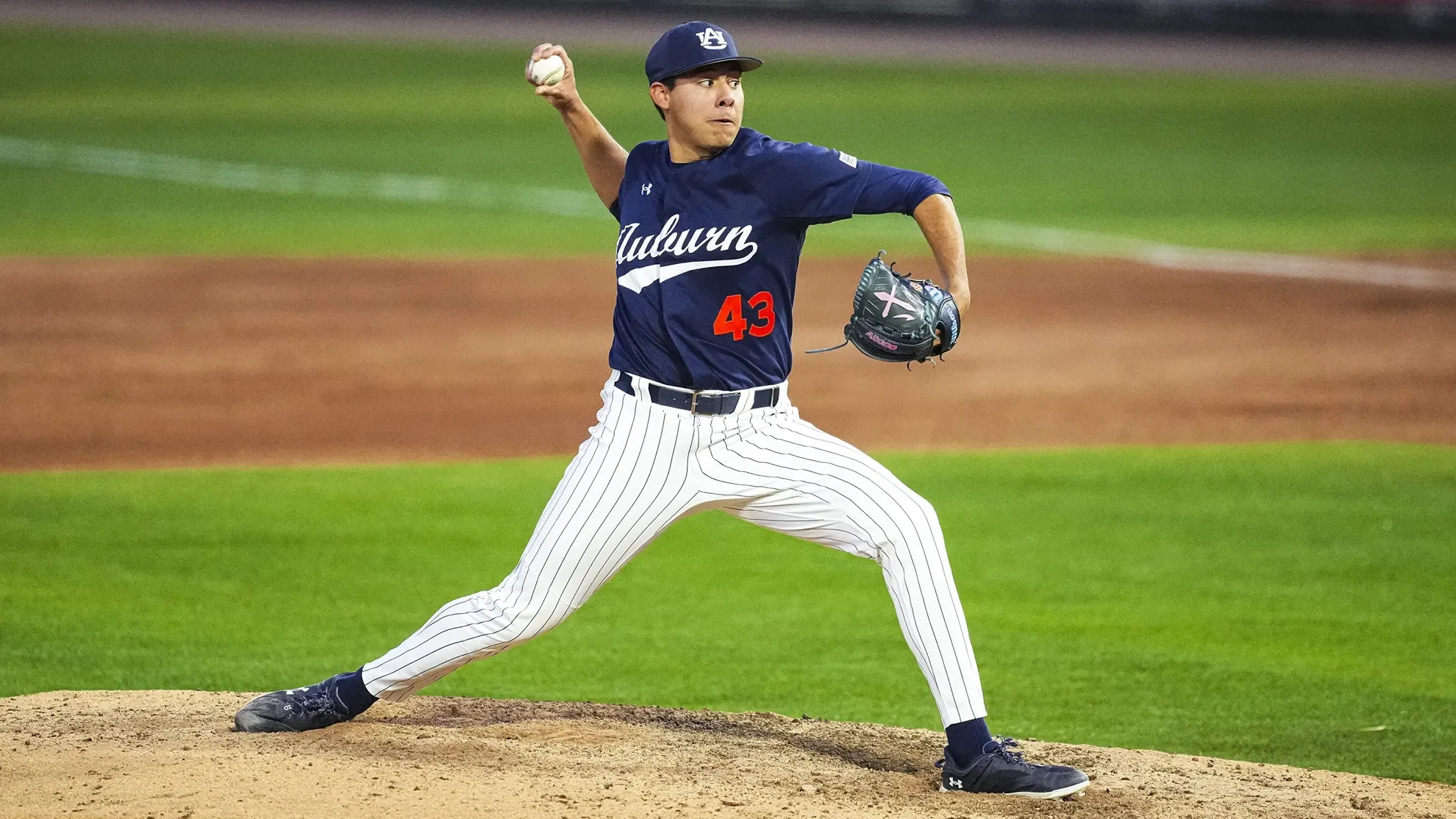
Petrovic was actually draft-eligible in 2025 as a redshirt freshman, but did not have the largest collegiate resume. Returning to the Auburn staff in 2026, Petrovic had himself a breakout campaign. The 6-foot-5 right-hander threw 92.2 innings as a key cog of the Tigers’ rotation, striking out 92 and walking just 24. His 6.5% walk rate was microscopic and bodes well for his professional development. Petrovic has a four-pitch mix that is somewhat traditional for a right-handed starting pitcher, but each component of his arsenal has intriguing traits for an organization. His fastball has moderate carry for a pitch in the 91-93 mph range, but gets good spin. The pitch is also one that can reach the mid-90s when he needs it.
Due to his size, some scouts and evaluators see him having a “velo boost” in pro ball, which could raise his ceiling. The next-most used pitch in his arsenal is his changeup, and it’s a dandy. Petrovic has a great understanding of how to use his changeup, and he relies on seam-shifted wake instead of reduced spin to get late action on it. The cambio has dynamic late movement, which allows it to sequence very well from the fastball. His slider has sweeper tendencies, sitting at 79-80 mph consistently; the pitch also lands as a strike consistently, and he has good command despite the shape of the pitch not being an outlier. He also features a cutter in the upper 80s that serves as a good bridge pitch, allowing the right-hander to generate weak contact and sequence the rest of his arsenal. Petrovic is a sequencer through and through and has an advanced understanding of how his stuff plays off each other. If he can have a velo boost in pro ball, his ceiling gets higher, but his pure pitchability at the time of the Draft has starting pitcher written all over his profile.
*DOT* from Auburn RHP Alex Petrovic after four straight scoreless innings.
Feels like one of the more slept on prospects in the 2026 Draft. Running a 28% K-Rate and just a 4% BB-Rate. 53 K in 47 IP.
No. 235 on our Top 300 and rising.
?BOARD & REPORTS?pic.twitter.com/Wqh9W2Ekyh— Over-Slot Baseball (@OverSlot_) April 18, 2026
Round 8 – 245th Overall – OF Dom Battista, Oswego East HS (IL)
Coming out of Oswego East High School in Illinois, Dom Battista is the kind of prospect where the tools outmeasure the slash line. Battista’s setup in the box is that of a pure hitter, as he anchors his weight to the back foot and unloads with a moderate (but not excessive) stride. Battista keeps the bat in the zone for a long time, creating impressive bat speed with a fast but not violent rotation. He is, simply put, the kind of batter with all sorts of projectability written all over. His swing and movements are explosive, and he is developing his ability to go to the opposite field with regularity.
The raw swing itself is still in need of further development, as it can lack consistency from day to day. Defensively, Battista’s speed is the kind that plays out in center field, as he has the closing speed to make plays in any direction. Battista also possesses average to above-average arm strength, which, paired with his speed, presents long-term viability at any of the three outfield positions. His pure athleticism makes him a natural fit in center field, and he will likely be a prospect that teams take their time with in his development. It is worth noting that Battista did miss time in his spring season due to a hamate bone injury, which could see him drop into the round 6-10 range on Draft day.
‘26 OF Dom Battista (IL, @UIC_Baseball)
Explosive rounds with exits over 1️⃣0️⃣8️⃣. Simple fluid moves with strong hands. Semi uphill with more power coming.
6.53-runner.
A sleeper fav in the class. ??#Super60 || #MLBDraft || @PB_DraftHQ pic.twitter.com/lkyENgSWT4
— Shooter Hunt (@ShooterHunt) February 1, 2026
Round 9 – 275th Overall – LHP Cole Tryba, UC Santa Barbara
UC Santa Barbara has one of the most tantalizing prospects in this year’s draft in Jackson Flora, but his teammate, Cole Tryba, could be one of the steals of the draft. Tryba threw 43.1 innings for the Gauchos this season, appearing in relief in all but one game. The left-hander’s stuff, however, is what drives the train here. Tryba comes at batters from a lower-than-usual slot for a left-hander, but still manages to get plenty of ride on his fastball. The left-hander brings a deep arsenal of secondaries, though his usage of those could use some work.
Tryba’s slider is his go-to secondary, a big sweeper with late vertical break and plenty of glove-side movement. While the slider has been his go-to offering, there is a real possibility that his changeup is his strongest secondary. Coming from the same slot as the fastball, Tryba’s changeup produces uncomfortable swings and leads batters to expand the zone. Upping the use of the changeup would allow for his slider and fastball to play up against opposing batters, and the Padres organization knows a thing or two about left-handers and their changeups (see: Kash Mayfield, Omar Cruz). While there are some biomechanical concerns with Tryba’s landing on his delivery, he very much fits into the “let him start until he can’t” camp of pitching prospects. Based on stuff alone, he has the ceiling of a Cristopher Sanchez kind of arm due to the symbiotic relationship between his fastball and changeup, and developing the feel for his changeup and cutter will truly define how long he can last as a starter.
LHP Cole Tryba enters his junior year with a strong résumé: sub-3.65 ERA and 12.4+ K/9 in each of his first two seasons, and a 1.07 ERA in 25.1 IP in the Cape. His funky delivery helped produce the highest Whiff% of any LH sinker (29.8%, min 150) in 2025. @tryba51 @UCSB_Baseball pic.twitter.com/pCFngcrJeE
— UCSB Baseball Analytics (@SBBaseballData) January 30, 2026
Round 10 – 305th Overall – C Ryan Tayman, Cal Poly
Ryan Tayman is the sort of player who checks off all the boxes; he’s a ballplayer and a good one at that. Despite inconsistent raw power, Tayman’s in-game power has shown that there is potential for more in the exit velocity department than that which has already been seen in games. Tayman hit 18 home runs for Cal Poly this season, and his bat is what drives his ceiling. He also posted a walk rate north of 10% at 10.8%, and when he swings the bat, there is a sort of ruthless aggression in his approach. Tayman has strong pull-side power and can get to it more often than not. His swing allows him to get plenty of backspin on the ball upon making contact, which really plays when he swings at pitches in the zone. Tayman also has a tendency to expand the zone, which can mitigate the quality of contact he makes.
Ryan Tayman will need to be more selective when he expands the zone at the pro level, as a lack of adjustment in this area could be exploited by pro-level pitching. Defensively, Tayman has a strong arm that plays well behind the plate, but the rest of his tools behind the plate are roughly average. His framing and blocking are graded as average, while his transfers on throws force him to compensate with his arm strength. There is the risk that he does not stick behind the plate, but he has the offensive profile to end up at a corner, be it outfield or infield. Tayman has similar tools to Kerrington Cross when coming out of the draft, just with the ability to play catcher, while his relative youth plays both ways for him. On one hand, there is time and room for the Grover Beach, California native to work on his plate discipline and catching, but he has mostly filled out his frame, which limits projectability.
Cal Poly catcher Ryan Tayman, perhaps one of the most underrated backstops in Southern California ahead of the MLB Draft, has put together an outstanding season.
Here he is launching a home run to left-center field. pic.twitter.com/WFrDDUFHRh
— Anthony Arroyo (@AnthonyArroyo23) May 31, 2026

A born and raised San Diegan, Diego Garcia is a lifetime Padres fan and self-proclaimed baseball nerd. Diego wrote about baseball on his own site between 2021-22 before joining the East Village Times team in 2024. He also posts baseball content on his YouTube channel “Stat Nerd Baseball”, creating content around trades, hypotheticals, player analyses, the San Diego Padres, and MLB as a whole.
A 2024 graduate of San Diego State, Diego aims to grow as a writer and content creator in the baseball community.