Kodai Senga – More than a rumored fit for Padres at trade deadline?
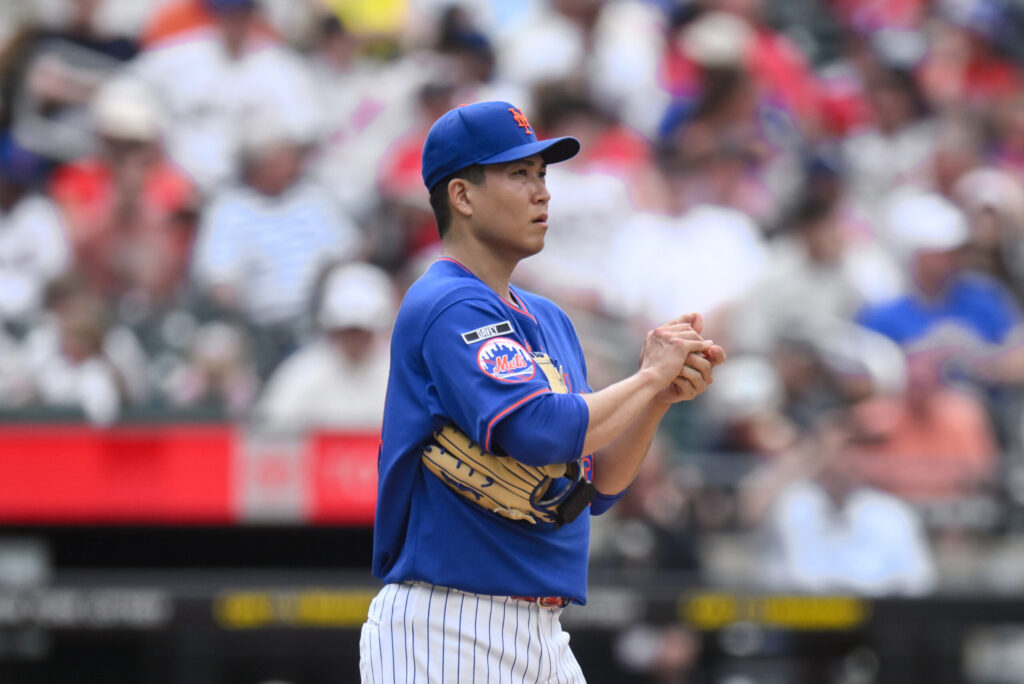
Mandatory Credit: John Jones-Imagn Images
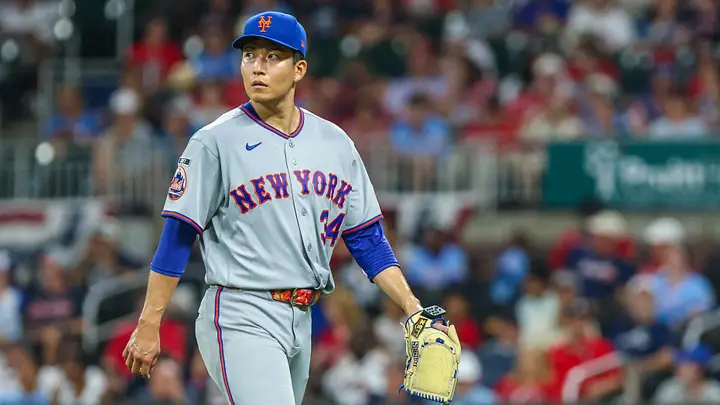
The San Diego Padres’ search for starting pitching depth has seen them explore any and all avenues. With the team reportedly in a position to add money instead of overspending prospect capital, a change-of-scenery candidate would be a bold, but potentially game-changing asset to add.
It’s easy to say nothing has gone right for the New York Metropolitans in 2026.
After an offseason spending spree, the Mets have spiraled into a seller’s position. Having dealt A.J. Minter and Freddy Peralta, New York could have more to sell by the deadline.
Right-hander Kodai Senga fits that bill, albeit for different reasons than their already traded arms. Senga was a high-profile addition back before the 2023 season, signing a five-year, $75 million contract with the Mets. The right-hander was an All-Star in his rookie season, pitching to a 12-7 record, 2.98 ERA, 3.63 FIP, and 29.1% strikeout rate in 166.1 innings. Senga averaged 5.2 innings per start in 29 games and was a stabilizing rock in a Mets rotation that was blown up at the trade deadline.
2️⃣0️⃣0️⃣
What an incredible rookie season for Kodai Senga! pic.twitter.com/AIrazHTMrC
— Just Baseball (@JustBB_Media) September 28, 2023
Unfortunately for Senga and the Mets, his 2024 season was marred by injuries. The right-hander missed most of the first half with a posterior capsule strain in his throwing shoulder. Senga made his season debut on July 26, striking out nine against the playoff-bound Braves, but also strained his calf. Though it appeared to be a season-ender, Senga surprisingly made the Mets’ playoff roster on their O-M-G run to the NLCS. The right-hander made three appearances that postseason, allowing seven runs in five innings. Senga was not at full strength in that postseason run, not throwing more than 34 pitches in any of his three outings.

2025 was a return to form for the former Fukuoka Softbank Hawks ace, at least in the first half. The right-hander pitched to a 1.47 ERA and 3.24 FIP over his first 13 starts. Senga looked to be back to his elite form, striking out 70 batters in 73.1 innings while issuing just 31 walks. That comes out to a 23.9% strikeout rate and 10.6% walk rate in that span. The injury bug returned once more, as the right-hander missed a month because of a Grade 1 hamstring strain. When he returned, he wasn’t quite the same player he was in the first half:
- First Half – 14 Starts, 77.2 IP, 1.39 ERA, 3.21 FIP, 74 K, 33 BB, 47.5% groundball rate, 23.8% K, 10.6% BB, 5.1% HR/FB
- Second Half – 8 Starts, 35.2 IP, 6.56 ERA, 6.11 FIP, 35 K, 22 BB, 45% groundball rate, 20.5% K, 12.9% BB, 20.5% HR/FB
Senga’s struggles were such to the point where the Mets demoted him to Triple-A in September to give younger arms a shot in the Majors. Senga was rumored as a trade candidate all offseason, but remained with the team come spring training. Starting the season in the rotation, Senga pitched well in his first two starts (11.2 IP, 3.09 ERA, 1.64 FIP, 16 K, 5 BB), but the wheels came off after that.
We’ve NEVER seen this version of Kodai Senga before…
And I’m extremely excited! pic.twitter.com/KMmo6i8xBx
— Nick Pollack (@PitcherList) April 1, 2026
In his next six starts, Senga delivered an almost untenable 12.43 ERA (10.05 FIP), allowing 29 earned runs in 21 innings. Senga walked almost as many batters as he struck out in that stretch (22 K vs 18 BB), which prompted the Mets to move him to the bullpen. Senga made four relief appearances, allowing seven runs in 10 innings before returning to the rotation on July 31.
So why would San Diego want Senga? It’s fairly obvious that the team needs warm bodies in the rotation, as their recent stretch of pitching chaos has seen them rely on any and all arms. JP Sears threw twice in four days, plus the duo of Griffin Canning and German Marquez have thrown fairly well since the team began employing the strategy. The Padres need some kind of consistency in the rotation to avoid overtaxing the bullpen, Tingler style. While the team has near-MLB-ready prospects, calling them up in the midst of a playoff race puts them in a challenging situation for any young arm.
Adding Senga gives San Diego an insurance arm with team control. The right-hander hasn’t been great in 2026, but there are some signs of what could be a serviceable starter. For one thing, Senga still throws fairly hard. His 96.2 mph average fastball velocity is in the top quartile of MLB pitchers, and his forkball remains his strongest pitch. This season, the “ghost fork” is his only pitch with a positive run value. His sweeper has been at the root of the issues. Senga throws the sweeper in the zone the most of any of his pitches, and that’s not a good thing in this case. Opponents are slugging .917 against the sweeper from Senga (yes, slugging). His fastball possesses good rising action, but mostly sets up the cutter and forkball. With his stuff being as potent as it can be, Senga has to be on the attack from the word go to be successful.
Part of what made him so successful in the past was his ability to mix his pitches and tunnel everything to set up a chase pitch. He has three pitches (forkball, slider, cutter) that have been good at generating chases. Another adjustment that Senga could make is something right out of one of his role models/mentors, Yu Darvish. When Darvish returned in 2025, he moved from the center of the rubber more towards the first base side or the third base side, depending on the opposing hitter’s handedness. For Darvish, this allowed his pitches to gain more perceived movement against opposing hitters. For Senga, whose main breaking pitches move east-west, moving to either side of the rubber could allow him to not only locate his fastball inside more often, but then set up more opportunities with his breaking balls and forkball.
Kodai Senga, Nasty 84mph Slider. ? pic.twitter.com/8Q7XKHS5dO
— Rob Friedman (@PitchingNinja) August 15, 2025
Financially, the Padres are reported to be in a position to take on payroll, albeit an unknown amount. Senga is due $14 million for 2027 and roughly $4.2 million for the remainder of the 2026 season. The Padres are likely to be able to take on the contract if they have financial flexibility due to the team’s upcoming sale. The Mets have made it publicly known that they don’t plan on retaining salaries in trade to increase a prospect return (as they did with Max Scherzer and Justin Verlander in 2023). San Diego would not need to part with much if they take on the contract. A projectable low-level player could be something that interests the Mets in this kind of deal.
Would adding Senga be a gamble? Yes, but how many options do the Padres have on the trade market. Brady Singer? Casey Mize? An Eric Lauer reunion and risk the second-coming of a River Ryan trade? The starting pitching market is a tough one to read, and if the Padres have faith in their pitching coaching and R&D to have Senga rebound, it could be worth a shot. When you’re one game out of the playoffs and plan to go for it, the time is now.

A born and raised San Diegan, Diego Garcia is a lifetime Padres fan and self-proclaimed baseball nerd. Diego wrote about baseball on his own site between 2021-22 before joining the East Village Times team in 2024. He also posts baseball content on his YouTube channel “Stat Nerd Baseball”, creating content around trades, hypotheticals, player analyses, the San Diego Padres, and MLB as a whole.
A 2024 graduate of San Diego State, Diego aims to grow as a writer and content creator in the baseball community.