The Padres’ road to bringing postseason baseball home to San Diego
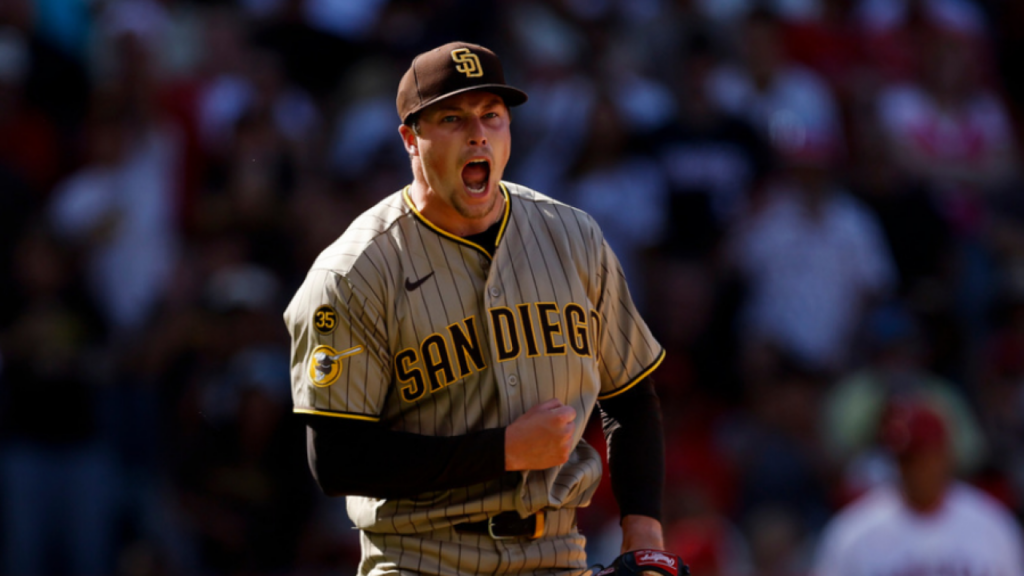
Credit: AP Photo

The Padres’ Road to Bringing Postseason Baseball Home to San Diego
The San Diego Padres have fought their way back to postseason baseball in San Diego. They endured an eight-game losing streak (their longest since 2013) and were viewed as potential sellers at the All-Star break. The Friars ended the season as the top Wild Card seed in the National League, securing a home series against the Chicago Cubs.
The Padres’ late-season run did more than secure a playoff spot. It brought the Wild Card Series back to Petco Park.
San Diego made the most of that home-field advantage by sweeping the Cubs in two games to advance to the National League Division Series. Game 1 was a shutout win, with Michael King throwing seven scoreless innings. Joe Musgrove capped off the game in his return to the mound. Musgrove recorded the final three outs in his first major league appearance in nearly two years. In Game 2, Gavin Sheets hit a two-run home run that helped secure a 4-1 win and send the Cubs on vacation.
Welcome back, Joe 💛 pic.twitter.com/nzPcwpw9E4
— San Diego Padres (@Padres) September 30, 2026
Sent that one to the Milky Way 💫 pic.twitter.com/fUeoYiLiQP
— San Diego Padres (@Padres) October 1, 2026
The road wasn’t free of bumps
At the All-Star break, the Padres sat at .500 with a 48-48 record. At the time, there was speculation about whether the Padres would sell at the trade deadline. Starting pitching was an obvious weakness with Nick Pivetta sidelined since April with right elbow inflammation. Joe Musgrove had not pitched in the majors since undergoing Tommy John surgery in October 2024. That meant Michael King and Walker Buehler were San Diego’s two traditional starters, with pitchers such as Randy Vásquez helping fill out the rotation.

Late July marked the first real turning point, as the Padres won five straight, including a sweep in Miami.
By the trade deadline, San Diego had gone from potentially selling to adding to its weak starting rotation. They entered deadline day having won eight of nine games. The Padres added left-hander Robbie Ray in a trade with the Giants and right-hander Casey Mize from Detroit. The acquisitions helped reinforce their rotation and confirmed San Diego was a buyer.
August looked like San Diego had gained some traction with a six-game winning streak, including a sweep of the Brewers. The Padres were then swept by Tampa Bay, but still finished August 17-11.
Things start to click in September
By early September, San Diego was still fighting to get into a Wild Card spot. That began to change during an eight-game winning streak from Sept. 6-14. The winning streak was highlighted by a come-from-behind win against the Nationals in which the Padres trailed by three heading into the eighth inning. They scored four runs in the eighth to win 5-4. Arizona had already won, so San Diego needed the win to keep pace.
Luis Campusano hits a bloop; Nationals let it fall, #padres lead 5-4 after being down 3 in the 8th! pic.twitter.com/eeXr9XyNIe
— Padres Central (@PadresCentral_) September 9, 2026
During their streak in September, Jackson Merrill had a great week. For the week ending Sept. 13, Merrill had a .429 average with three home runs and 12 RBIs, earning National League Player of the Week honors.
A lil' Merrill Madness (2x)
2nd home run of the day for Jackson Merrill makes it 8-2 #padres over the Nationals (24th of the year) pic.twitter.com/iDP8tBQjes
— Padres Central (@PadresCentral_) September 9, 2026
The Padres finished the streak with an 82-68 record and went from chasing Arizona to holding a Wild Card position and looking at how much higher they could climb.
Not how you start but how you finish
Major League Baseball is a marathon, with 162 games in the regular season spanning from April through September. With a record of 41-18 from July 24 through the end of the regular season, San Diego bounced right back into playoff contention.
There were periods when it looked as though they wouldn’t secure a Wild Card position, but San Diego not only secured a spot but also brought postseason baseball back home. Unexpected contributors such as Dustin Harris helped round out the offense, hitting .322 with 14 RBIs in 28 games. Harris also had the go-ahead RBI against the Dodgers to clinch the playoffs. With the offense back online, a stronger starting rotation, and an already established and solid bullpen, the Padres looked complete and competitive.
To end the regular season, San Diego went to Los Angeles to play the Dodgers, looking to clinch the playoffs, in their second-to-last series. After losing game 1 to the Dodgers, they went on to win the next two, securing their Wild Card position and popping champagne inside the visitors’ clubhouse at Dodger Stadium.
Punched our ticket. pic.twitter.com/zFx3hcItP5
— San Diego Padres (@Padres) September 25, 2026
The Padres are celebrating their traditional champagne and beer celebration inside the Dodger Stadium clubhouse. 🍾#CLINCHED #ForTheFaithful pic.twitter.com/7PmG4Aopsw
— San Diego Strong (@PadresStrong) September 25, 2026
Less than three weeks earlier, Arizona sat a half-game ahead of San Diego for the final Wild Card spot. By the final weekend, the Padres had climbed to the top Wild Card spot while Arizona arrived at Petco Park fighting to keep its postseason hopes alive.
San Diego took two of three from Arizona to close the regular season. The Phillies’ win officially eliminated the Diamondbacks from the postseason, while the Padres finished their climb to the top Wild Card spot.
Postseason San Diego
The road to the postseason was far from easy, but San Diego is making it look that way now. The offense is producing, the rotation has stabilized, and the bullpen continues to end games.
Earning home-field advantage gave the Padres the chance to play in front of a Petco Park crowd that showed up and got loud throughout the Wild Card Series. San Diego made the most of it by sweeping Chicago and advancing to the National League Division Series.

A San Diego local, Bill brings his interest in the city’s sports to East Village Times. He looks beyond the final score to tell the stories of the people and moments that shape each game.